

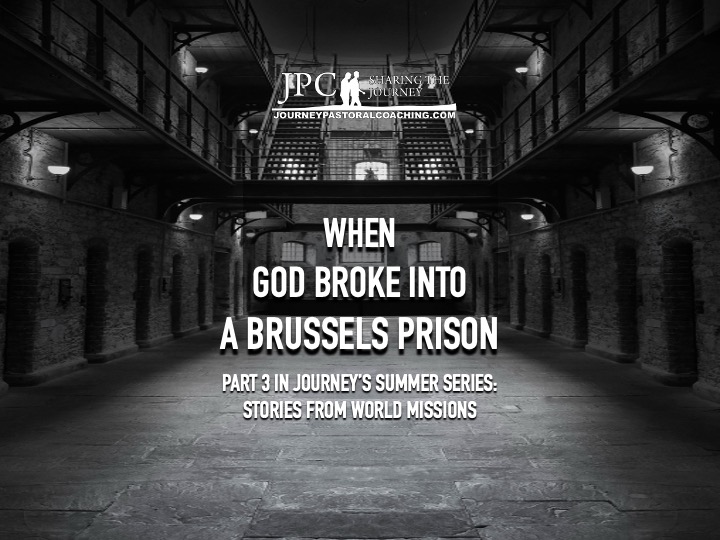
When God Broke Into a Brussels Prison
Editor’s Note: This is Part Three in Journey’s summer series, “Stories From the World of Missions.” Every two weeks this summer, we publish an article recounting a story from the experiences of our founder-director who was privileged to serve two decades as a missionary in Europe. We hope you will join us here for a summer of rejoicing at the works of our great God. This story looks back at a gloomy night in Brussels, Belgium when God broke into prison.
My wife, daughters, and I served as missionaries in the nation of Belgium. Most of our service was in Wallonia, specifically the Borinage region, among the French-speaking people of this tripartite nation. We lived in the beautiful and tradition-rich city of Mons, just a dozen miles north of the French border. The Dutch painter Vincent Van Gogh made this region his home for a time, pastoring and ministering the Gospel to the region’s coal miners (a part of Van Gogh’s life that historians conveniently omit). How we loved our time in the Borinage and the many friends with whom we were privileged to share life.
As missionaries, we were members of a great ministry team. Every missionary and family worked together as colleagues and friends in a shared effort to reach the Belgian people with the Gospel of Jesus. This close relationship led to inviting and being invited to help one another in our ministries to the different regions and demographics of the nation.
One colleague served as a chaplain in the Belgian prison system. This great friend faithfully ministered to inmates in several prisons, sharing the Gospel, pastoring, discipling, and even helping them earn degrees from our denomination’s international university. He was a front-line missionary-pastor to men with little to live for, giving them the hope that is found only in Christ.
THE FORTRESS
On one occasion, this friend invited me to preach in one of Belgium’s darkest hollows: St. Gilles Prison in the capital city of Brussels. Built in 1884 in the Tudor Revival style, it was intentionally designed to evoke the look and feel of a medieval fortress: elevated towers, pointed arches, and massive stone walls. As one of Belgium’s two highest maximum-security prisons, St. Gilles was an imposing and impregnable fortress that had been used by the Nazis during World War II to incarcerate and even execute political prisoners. Dark and foreboding, and given its history, St. Gilles could easily have served as the setting for an old black-and-white horror movie.
As I approached the prison that dark and misty night, St. Gilles was at its most formidable: ebony-hued, menacing, and foreboding. Like a cemetery at midnight on Halloween, it was a place you walk away from, not toward.
Because of its status as a maximum-security prison, gaining permission to enter the prison as a visiting pastor was a maze of red tape. Weeks ahead of my visit, I was required to submit a formal application, references, and supporting documents.
Once approved, the process of physically entering the prison was equally daunting, a labyrinth of document examinations, hard-stare questions, and a thorough hand search – layer after layer of assessment until I, Bible in hand, was led to a prison guard and sternly instructed to do exactly as he told me, nothing more, and nothing less.
I can still hear the iron doors of this dungeon definitively clanging shut behind me like Alcatraz. Everything about it made it clear that nothing unapproved by the State Machine or its local wardens could enter these walls where many of those convicted as the nation’s most violent waited long years to die.
The guard led me through the maze of corridors and steel doors that clanged. At each door, I was instructed to stand back and wait until the guard had opened it and motioned me through. Corridor after corridor, door after door, we silently walked. The guard unlocked a final heavy metal door and instructed me to enter. He told me to stand at the front of the clammy room and not to move. He said he would leave, lock the door behind him, and gather the convicts who would attend the service that night. Again, he reminded me not to move around the room but to stand at the front and wait for his return.
Standing alone in this large, cold room, I thought of Shakespeare’s line, “Silent as the grave.” It was an unnerving wait for the guard’s return. Though I was about to minister in French, I prayed fervently in my birth language of English.
THE ROOM
After about a quarter of an hour, I heard the key turn in the lock of the door. Into the room walked a line of guards – guns in hand – who took positions around the room. Next came two dozen or so prisoners. As they marched into the room, they filed in along the few rows of seats, each individual standing silently in front of a chair. Behind these men came more guards, each of whom was also armed. They silently filled the gaps between their colleagues, each man a human gun placement turned facing us. The door locked, and everyone in place, the chief guard instructed the prisoners to be seated. Taking his position at the door, he informed me that I could begin.
My congregation that night was, by far, the most unique I had ever encountered. Seated before me were men convicted of the worst crimes imaginable. Or even unimaginable. Ringing the room completely, even behind me, were guards with guns at the ready. Each of the prisoners had chosen to be there; the guards had been instructed to be there. Which of the two groups was most open to the Gospel was an open question. All I knew was that God had arranged this meeting at this place and time to reveal Jesus Christ and meet with every man in this room.
Everything was on a fixed schedule, and so, knowing my time was limited, I opened the service with a heartfelt prayer for every man there, asking the Holy Spirit to minister to each one exactly what he needed. I waited in silence on the Holy Spirit, praying for myself as well as for them.
I then opened the Bible and ministered the Word of God to these men – all of them, prisoner and guard alike – presenting Jesus as the Bible presents Him to us: transcendent God, Creator, King, and Lord; immanent Savior, Shepherd, Counselor, and Healer. I presented Jesus in His infinite glory and power. I offered Jesus in all His infinite grace and love.
As I preached, a young man sitting directly in front of me openly wept. Throughout the message, he sat with his head bowed, weeping, even visibly shaking at times. It was clear that his soul was in great pain. Fellow prisoners around him did not seem shocked or unfeeling to his pain but could only look on and listen as his sorrow flowed under the ministry of the Word of God.
As I preached, I asked God to give me direction in bringing His word in a personal way to this young man. I felt compelled to emphasize the grace and mercy of God, the free gift of God to anyone who sincerely seeks him – with God, there is no sin too great to separate us from God’s forgiveness and cleansing us, no wall strong enough to exclude us from sonship with Him. Because of what Christ did on the Cross, every man – any man – can come to God and be received on equal footing.
THE BREAK-IN
I did not close the service in “a word of prayer.” No, nothing so perfunctory; I prayed earnestly as our final act of worship. Fervently, I prayed that God would drive His Word deeply into our souls, that He would open our eyes to see the truth, our hearts to receive it, and act on it. I prayed that every man there would return to his cell (if a prisoner) or home (if a guard) with a real sense of the presence of God that comes from recognizing what He has done for us in Christ.
I then asked my congregation to bow their heads and close their eyes. I asked if any that night wanted to believe on Jesus Christ as Lord and Savior. Was there anyone among us who understood our place as sinners before a holy God, in need of the salvation that only Jesus Christ can give?
As I made this call, I looked over the gathered men. To my great relief, the young man who had wept during the service had lifted his head and was looking directly into my eyes. His hand raised, he nodded. Not a feeble “accept Jesus into your heart” nod, but a strong, “Just As I Am” commitment and resolve.
Several other prisoners raised their hands as well. I led in prayer: salvation for those who had believed on Christ as Savior, His presence and direction in all their lives.
With this, the service ended.
The head guard stepped up and instructed the prisoners to stand to their feet and file out of the room. The young man whose sorrow had been so evident looked intently at me as he left, his gaze silently voicing a thank you for the ministry God had brought into his life.
It was a moving moment in my life and ministry, one that became even more so when I later learned that this young man was in prison – and would be in prison for the rest of his life – for the crime of murdering his own mother.
THE BREAKOUT
This young man lived in a prison, external and internal—a prison of long, slow death.
But like water finding its way through the cracks of this stone fortress, God’s grace would not be denied. It found its way in, not just into this fortress prison, but into the heart of this man and of all the men whose crimes had imprisoned them there. Life had crushed death. His earthly home was a prison cell, but even there, he was free. And, thank God, he had my missionary friend to walk with him in his new life in Christ.
The same grace that flows in your church on a Sunday morning in Alabama, Nebraska, or Washington flowed through the stone walls and iron doors of that prison in Brussels, Belgium that grave-dark night. Down the corridors, through the gates and doors, and past the armed guards, it moved into the hearts of men who needed God’s grace but did not deserve it.
Just as you and I need God’s grace but do not deserve it. Yes, “just as,” as in equally so.
The grace of God met these men where they were. Where they were. Not where they should have been or could have been, but where they were. Despite their past and future, their darkened hearts and minds, their evil attitudes and actions, the grace of God found its target, and they responded with faith.
Just as God’s grace met me where I was as a 16-year-old boy sitting in the comfort and beauty of a church sanctuary amidst caring and kind people.
Though my surroundings were much more attractive and my life much more acceptable to others, I stood just as darkened and evil, equally in need of the same grace these men in St. Gilles needed.
And I still need God’s grace today. Bless the name of the Lord! It is still flowing freely to me today.
FINAL THOUGHTS
Let’s continue taking the Gospel of Jesus to all the world as He commanded (Matthew 28.18-20).
Let’s continue going into the darkest of the dark places with the Gospel of Jesus Christ.
Let us never give up on those enslaved by darkness and sin, whatever they have done. Let’s continue to give them the Gospel – the Good News – of Jesus. Let’s believe the Gospel can do what the Bible says it can do – break the chains of darkness and set the sinner free to be a son of God.
Let’s continue supporting missionaries who serve in those dark places, men and women who know those dark places – their languages, power sources, nuances, and networks. They do the daily, in-the-trenches battle that only they can do. They and their labor are worthy of our support.
And pastors, let’s remember that the grace we preach to others is the grace we need in our own lives. However large or small our ministry, however many or few our followers, we need God’s grace each and every day of our lives. Even “success” can be a prison for us, a prison where we need the grace of God to break in and set us free.
_______
NOTE: Journey Pastoral Coaching exists to provide pastoral coaching to Millennial ministers.
Saddled with large student debt, just beginning to set up homes and start families, and serving in low paying first and second positions, Millennials are those who most desire but can least afford to pay for pastoral coaching.
We are able to do so thanks to the faithful and generous support of individuals and churches like yours who want to see young leaders not only enter the ministry, but remain in the ministry.

Now, more than ever, we need your help.
If you or your church would like to help Millennial ministers across the US and overseas build strong for a lifetime in ministry, please click here to support Journey monthly or with your one-time gift. Thank you.
We also invite you to click and subscribe to our twice-monthly blogs at journeypastoralcoaching.com
