
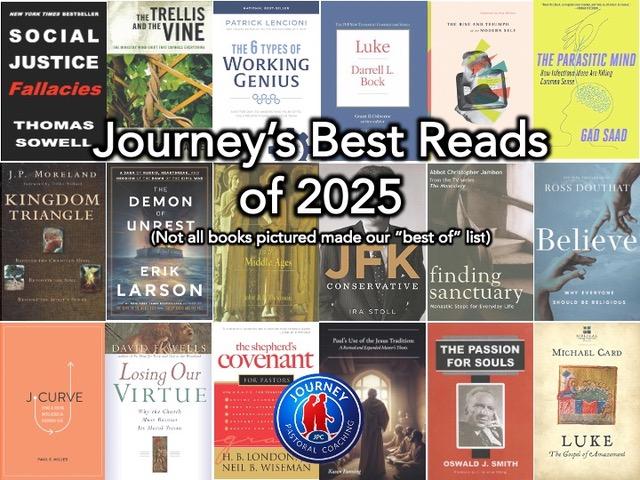
Journey’s Best Reads of 2025
As we turn the final pages of the book on 2025, I offer my annual list of favorite reads for the year. This was another great reading year with many happy hours invested in the “Big Three” of mellow music, strong coffee, and a good book.
As always, this is not a list of my favorite books published in 2025 but books read in 2025. If a book is on my “Best Of” list, I recommend you read it in 2026.
The publishing date range on this year’s reads is once again wide: from 1952 to 2024.
As is true every year, in 2025 I read a few great books, some good books, and some why-the-big-deal books.
I am decidedly not a fad reader. Fad reading breeds fat minds. Jack Kerouac said it this way:
“Great things are not accomplished by those who yield to trends and fads and popular opinion.”
When people tell me, “You just have to read this latest and greatest book,” I run the other way. I am not a follower of crowds when it comes to books and authors. I’ve often said I’d like to compile a list of each year’s “must read” books and then track their “must read” status in the coming years. With limited time and resources, I wait for the dust to settle before putting my money down on a book that may be a great investment of my time and money or a waste of both.
Rather than follow the “latest-and-greatest,” I follow the sage counsel of C.S. Lewis, who said,
“It is a good rule, after reading a new book, never to allow yourself another new one till you have read an old one in between.”
It’s advice I follow with joy as rereads of previously read books are like visits with the oldest and best of friends. Every reading of them brings ever deeper riches. How can you beat an evening with C.S. Lewis, Francis Schaeffer, Elisabeth Elliot, Os Guinness, or Thomas Sowell,
Lewis again:
“I can’t imagine a man really enjoying a book and reading it only once.”
HOW THIS YEAR’S READING IS PRESENTED:
This year’s reading is presented in four lists:
1. The complete list of books I read;
2. Old friends I read again;
3. Books on worldview and culture;
4. The most important reads of 2025.
THE COMPLETE LIST OF BOOKS READ IN 2025 (LISTED ALPHABETICALLY):
100 Days In the Secret Place by Gene Edwards (editor). 2015. 218 pages
A Woman of No Importance by Sonia Purnell. 2020. 368 pages.
Before You Go: Wisdom From 10 Women by Emily Bennett (ed.). 2023. 172 pages.
Believe by Ross Douthat. 2025. 216 pages.
Finding Sanctuary by Christopher Jamison. 2006. 192 pages.
Fire and Rain by David Browne. 2011. 392 pages.
God Has a Name by John Mark Comer. 2024. 288 pages.
Handbook for Battered Leaders by Janis Balda and Wesley Balda. 2013. 223 pages.
Imperfect Living. Perfect Grace by Dr. E.M. Johnson. 2023.196 pages.
Jeux de glace by Agatha Christie. 1952. 218 pages.
JFK The Conservative by Ira Stoll. 2013. 274 pages.
Kingdom Triangle by J.P. Moreland. 2017. 240 pages.
Lightfoot by Nicholas Jennings. 2017. 328 pages
Lions and Scavengers by Ben Shapiro. 2025. 256 pages.
Losing Our Virtue: Why the Church Must Recover Its Moral Vision by David F. Wells. 1998. 228 Pages
Luke by Darrell Bock. 1994. 412 pages.
Luke: The Gospel of Amazement by Michael Card. 2011. 272 pages.
The Passion for Souls by Oswald J. Smith. 1984, 128 pages.
Paul’s Use of the Jesus Tradition by Kasen Fanning. 2025. 96 pages.
Psalms By The Day by Alec Motyer. 2016. 422 pages.
Richard the Lion Heart by W.B. Bartlett. 2019. 408 pages.
Social Justice Fallacies by Thomas Sowell. 2023. 223 pages.
The Age of Chivalry by National Geographic. 1969. 427 pages.
The Chronicles of Narnia by C.S. Lewis. 1956. 800 pages.
The Demon of Unrest by Erik Larson. 2024. 592 pages.
The J-Curve by Paul E. Miller. 2019. 336 pages.
The Journey by Os Guinness. 2001. 270 pages.
The Parasitic Mind by Gad Saad. 2020. 240 pages.
The Rise and Triumph of the Modern Self by Carl R. Trueman. 2020. 432 pages.
The Shepherd’s Covenant by H.B. London and Neil B. Wiseman. 2005. 217 pages.
The Six Types of Working Genius by Patrick Lencioni. 2022. 208 pages.
The Trellis and the Vine by Colin Marshall and Tony Payne. 2009. 196 pages.
The Western Church in the Middle Ages by John A Thomson. 1998. 293 pages.
What’s So Funny? by Tim Conway. 2013 248 pages.
You Never Know by Tom Selleck. 2024. 524 pages.
OLD FRIENDS READ AGAIN
This year I reread these old friends. Most would make my “Best Reads of the Year” list in any year.
Jeux de glace by Agatha Christie. 1952. 218 pages.
Psalms By The Day by Alec Motyer. 2016. 422 pages.
The Chronicles of Narnia by C.S. Lewis. 1956. 800 pages.
The Journey by Os Guinness. 2001. 270 pages.
The Shepherd’s Covenant by H.B. London and Neil B. Wiseman. 2005. 217 pages.
The Six Types of Working Genius by Patrick Lencioni. 2022. 208 pages.
The Trellis and the Vine by Colin Marshall and Tony Payne. 2009. 196 pages.
There’s a Little Girl in Every Daddy’s Heart, Volumes 1 and 2. 2015 and 2017.
UNDERSTANDING THE TIMES BOOKS
These are uniquely challenging times for pastors and churches. Churches continue to hemorrhage attendees, and many who remain in the church cannot address the issues of our times substantively.
Two primary reasons are that the Church is, by and large, unconcerned with thinking Christianly, having a Christian worldview perspective. Where 66% of Americans self-identify as Christian, only 6% have a Christian worldview. (Click here to read the 2025 Barna survey)
For this reason, I continue to earnestly encourage Journey members to read on the subject of worldview. Pastors who give their people the lens of a Christian worldview and teach them how to use it will not only see their churches strong and stable, but these churches will be an oasis for nonbelievers searching for truth and meaning in this often-upside-down world. Churches that neglect to teach worldview will eventually go the way of the world (I John 2.15-17)
Several books I read this year focus on worldview directly or indirectly, and so, address our times and culture. They deal with the foundational issues that help us understand the changes taking place in America and how Christians should address them. Books by Os Guinness, Nancy Pearcey, and Francis Schaeffer are always essential reads on church and culture. Read anything by them you can find. Books by Sowell are essential reads as well; I reread at least one Sowell book every year.
The Worldview Books I Read This Year:
Believe by Ross Douthat. 2025. 216 pages.
Kingdom Triangle by J.P. Moreland. 2017. 240 pages.
Lions and Scavengers by Ben Shapiro. 2025. 256 pages.
Losing Our Virtue: Why the Church Must Recover Its Moral Vision by David F. Wells. 1998. 228 Pages
Social Justice Fallacies by Thomas Sowell. 2023. 223 pages.
The Journey by Os Guiness. 2001. 270 pages.
The Parasitic Mind by Gad Saad. 2020. 240 pages.
The Rise and Triumph of the Modern Self by Carl R. Trueman. 2020. 432 pages.
The Western Church in the Middle Ages by John A Thomson. 1998. 293 pages.
THE BEST READS OF 2025
In alphabetical order, A “Baker’s Dozen” of favorite reads for 2025. Each title is followed by the author’s name and a brief description of the “what” and “why” that lead to the book making our list. Enjoy.
1. Believe by Ross Douthat. 2025. 216 pages.
Publisher: Do you ever wish you had more faith? Here is a blueprint for thinking your way from doubt to belief.
As a columnist for the New York Times who writes often about spiritual topics for a skeptical audience, Ross Douthat understands that many of us want to have more faith than we do. Douthat argues that in light of what we know today it should be harder to not have faith than to have it.
With empathy, clarity, and rigor, Douthat explores:
- Why nonbelief requires ignoring what our reasoning faculties tell us about the world
- How modern scientific developments make a religious worldview more credible, not less
- Why it’s entirely reasonable to believe in mystical and supernatural realities
- How an open-minded religious quest should proceed amid the diversity of religious faiths
- How Douthat’s own Christianity is informed by his blueprint for belief
With clear and straightforward arguments, Believe shows how religious belief makes sense of the order of the cosmos and our place within it, illuminates the mystery of consciousness, and explains the persistent reality of encounters with the supernatural. Highly relevant for our current moment, Believe offers a pathway for thinking your way from doubt into belief, from uncertainty about our place in the universe into a confidence that we are here for a reason.
Note: Douthat discusses worldview, pointing out that Christianity is not just a faith system, but a description of reality: to see the world and universe as they are, Christianity is the one mindset that makes sense. This means that Christianity is much more than a “whatever works for you” religious view, one of many that are not The Truth, but A truth. Douthat walks the reader through the universality and reality of The Faith. A strong read. Turn off your phone and focus.
2. Kingdom Triangle by J.P. Moreland. 2017. 240 pages.
Publisher: J.P. Moreland—Christian philosopher, theologian, and apologist—issues a call to recapture the drama and power of kingdom living—to cultivate a revolution of Evangelical life, spirituality, thought, and Spirit-led power.
Drawing insights from the early church, he unpacks three essential ingredients of this revolution:
- Recovery of the Christian mind.
- Renovation of Christian spirituality.
- Restoration of the power of the Holy Spirit.
Western society is in crisis: the result of our culture’s embrace of naturalism and postmodernism, and a biblical worldview has been pushed to the margins. Christians have been strongly influenced by these trends, with the result that their personal lives often reflect the surrounding culture more than the way of Christ, and the church’s transforming influence on society has waned as a result.
Kingdom Triangle is divided into two major sections:
- The first examines and provides a critique of secular worldviews and shows how they have ushered in the current societal crisis.
- The second lays out a strategy for the Christian community to regain the potency of kingdom life and influence in the world.
Moreland believes that evangelical Christianity can mature and lead the surrounding society out of the meaningless morass it finds itself in with humility and vision. With clear insight, he puts the thoughtful Christian in a position to understand our current cultural struggle and to return to a responsible presentation of “the way of Christ” as not just a way of right living, but also a way of knowledge and meaningful life.
Note: Moreland presents three points on a triangle, emphasizing the essential nature of each and their interconnectedness: thinking Christianly, deep spirituality, and the Holy Spirit’s intentionality in powerfully working in our lives. Moreland calls for an aggressive passion for and pursuit of each of these. Living this way, Christians can then present the Christian worldview with intellectual excellence and spiritual demonstration. In other words, what we believe is not just a belief, but an accurate view of reality and the way to live holistically in reality. He writes that this can be the church’s strongest apologetic in a world that has embraced worldviews that are not only false but also destructive.
3. Losing Our Virtue: Why the Church Must Recover Its Moral Vision by David F. Wells. 1998. 228 Pages
Publisher: In Losing Our Virtue, theologian David Wells argues that the Church is in danger of losing its moral authority to speak to a culture whose moral fabric is torn.
Although much of the Church has enjoyed success and growth over the past years, Wells laments a “hollowing out of evangelical conviction, a loss of the biblical word in its authoritative function, and an erosion of character to the point that today, no discernible ethical differences are evident in behavior when those claiming to have been reborn and secularists are compared.” The assurance of the Good News of the gospel has been traded for mere good feelings, truth has given way to perception, and morality has slid into personal preference.
Losing Our Virtue is about the disintegrating moral culture that is contemporary society and what this disturbing loss means for the church. Wells covers the following in this bold critique: how the theologically emptied spirituality of the church is causing it to lose its moral bearings an exploration of the wider dynamic at work in contemporary society between license and law an exposition of the secular notion of salvation as heralded by our most trusted gurus–advertisers and psychotherapists a discussion of the contemporary view of the self how guilt and sin have been replaced by empty psychological shame an examination of the contradiction between the way we view ourselves in the midst of our own culture and the biblical view of persons as created, moral beings Can the church still speak effectively to a culture that has become morally unraveled? Wells believes it can. In fact, says Wells, no time in this century has been more opportune for the Christian faith–if the church can muster the courage to regain its moral weight and become a missionary of truth once more to a foundering world.
Note: If I could recommend only one book from my 2025 reading, it would be this one. It addresses the latent power of God in the church and its ability to tap into that power if it will. Like a physician, Wells accurately diagnoses the church’s health, identifying its weaknesses and why they exist. He then offers a prescription of promise, one that is organic and natural rather than technical and artificial. If the church can rediscover and reconnect with its DNA as described in the New Testament, it can once again be a channel of God’s glory to believers and the world. But to do this, the church must be willing to listen to the physician and take its medicine rather than moving from one fad supplement to another “new and improved” one. The church must regain its moral weight so it might then carry the weight of God’s glory.
4. Psalms By The Day by Alec Motyer. 2016. 422 pages.
Publisher: Following on from the successful and much acclaimed Isaiah by the Day, Alec Motyer leads us through the Psalms in this new devotional translation. Day by day you will read freshly translated passages from the Psalms and have an opportunity to explore the passage further through the author’s notes and devotional comments.
Note: Motyer offers a unique and enjoyably readable treatment of the Psalms; how deeply into the text and commentary the reader goes is up to the reader. First, Motyer has freshly translated the text from the original language. This reading by itself is easily worth the price of the book. Then Motyer offers more: concise commentary on his translation and the text in the margins. But the author is still not finished: at the conclusion of each section of Psalms (usually 2-4 Psalms), he ties up the package’s ribbons, giving the reader a one-page devotional thought built on the structure and major themes of that section. Psalms By the Day is a unique look at the psaltery of God’s people, combining a new translation with a taste of the scholarship that went into the translation and a thoughtful devotion. I try to read the Psalms daily. I have found Motyer’s work to have greatly refreshed this spiritual discipline. If you love the Psalms, you’ll treasure Psalms By the Day. If you haven’t yet come to love the Psalms, here is just the book to help you come to know and treasure them.
5. Social Justice Fallacies by Thomas Sowell. 2023. 223 pages.
Publisher: The quest for social justice is a powerful crusade of our time, with an appeal to many different people, for many different reasons. But those who use the same words do not always present the same meanings. Clarifying those meanings is the first step toward finding out what we agree on and disagree on. From there, it is largely a question of what the facts are. Social Justice Fallacies reveals how many things that are thought to be true simply cannot stand up to documented facts, which are often the opposite of what is widely believed.
However attractive the social justice vision, the crucial question is whether the social justiceagenda will get us to the fulfillment of that vision. History shows that the social justice agenda has often led in the opposite direction, sometimes with catastrophic consequences.
More things are involved besides simply mistakes. All human beings are fallible, and social justice advocates may not necessarily make any more mistakes than others. But crusaders with an utter certainty about their mission are often undeterred by obstacles, evidence or even fatal dangers. That is where much of the Western world is today. The question is whether we will continue on heedlessly, past the point of no return.
Note: Again, I read a book by Thomas Sowell every year. His clarity is sorely needed in this age of muddled thinking. Someone has said, “Any time we put an adjective before the word ‘justice,’ we no longer have justice. Economic justice, racial justice, environmental justice—any form of ‘social’ justice which seeks to ‘correct’ actual justice—undermines justice.”
Even as you read those words, doubtless, you felt an emotional response that may have even overwhelmed or suppressed your intellectual or rational response. This, Sowell argues, is a part of the problem: in many ways, justice has become an emotional cause at best, an ideological crusade at worst, rather than a principle or virtue. Thematically, Sowell seeks to bring the reader back to the historical definition of justice. He does so by organizing his book around four “fallacies” that serve as the foundations of these fallacies, building his arguments on scientific evidence rather than the emotion-driven rhetoric that led to the revolutions in France and Russia and their eventual self-destruction. Sowell reminds the reader that while false justice leads to tyranny, true justice leads to self-determination, the goal of all freedom-loving people.
6. The Chronicles of Narnia by C.S. Lewis. 1956. 800 pages.
Note: What is left to be said about this literary Hall of Fame classic? Seven books that will transport you out of this world and into the world of Aslan (and Jesus). Just read them. And then reread them. The only real decision is how to read them: chronologically or by publishing date. My annual dilemma. This year, I read them in order of their place in Narnian history.
7. The J-Curve by Paul E. Miller. 2019. 336 pages.
Publisher: “This book will revolutionize the way you look at your suffering.” Joni Eareckson Tada, Founder, Joni and Friends
Do we have the wrong map for the Christian life?
Life’s inconveniences, disappointments, and trials can leave us confused, cynical, and eventually bitter. But the apostle Paul traces out the path of dying and rising with Jesus―what Paul Miller calls the “J-Curve”―as the normal Christian life.
The J-Curve maps the ups and downs of daily life onto the story of Jesus. It grounds our journeys not in some abstract idea but in union with Christ and his work of love. Understanding our lives in light of the J- Curve roots our hope, centers our love, and tethers our faith to Christ.
Note: I wholeheartedly agree with Joni: this life can revolutionize your life and the way you look at suffering. Miller offers followers of Jesus a tremendous tool for “gospelizing” our lives. The truth be told, most Christians believe the Gospel of Jesus and then tuck it away for the end of life when they will need it, not realizing that we need it every day, not just for our salvation, but for our sanctification – our being set apart unto Jesus. The Gospel of Jesus empowers us to live for Jesus. It provides a lens for understanding our life in Christ, especially when we are suffering or simply going through difficult times. The author gives the reader a lens for understanding all of life, especially suffering. The Cross, burial, and resurrection each become map points for understanding where we are in our journey and what God is doing in us at this point. This was the featured text in our 2025 retreats at Journey. I continue to hear from retreat attendees how much this book continues to speak into their lives and to give them understanding.
8. The Journey by Os Guinness. 2001. 270 pages.
Publisher: Every person has a unique calling to count for good. An entrepreneur of life is one who responds to this call, who takes it on as a creative challenge, a venture of faith for the sake of good.
How do you hear and answer your call?
In Entrepreneurs of Life, Os Guinness guides you through the Western tradition to understand what calling is and how you can respond. From the journals and letters of men and women who fought slavery, reinvented healthcare, and composed great music, you’ll find models to follow as you discover and answer your own call.
The events of life can stop you in your tracks and raise big questions: What is the meaning of my life? How should I live it? Where did I come from? What is my eventual destiny? To search for answers is to embark on the most important journey of your life.
In The Journey, you can investigate answers from three major perspectives: modern secularism, Eastern philosophy, and Christian faith, and then form your own conclusions. If you or someone you know is engaged in a quest for faith and meaning, The Journey can help you find answers worthy of your time and commitment.
Note: Os Guinness is a marvel. He blends the three essentials of good writing: solid content, crystal clarity, and enjoyable readability. If I could read only one author outside the Bible, it would be Guinness. He asks the questions that all humans ask, and, rather than lecture us, leads us on a journey of examination and arrival in the truth. The Journey is a Masterclass in that exercise. Guinness has points to make, and he makes them well: life has an origin and creator, meaning, and an ultimate destination. Like the North Star, these things are fixed outside of us and our control. But each of our journeys under this light is different. How do we navigate life and its changing waters? How do we understand our place? How do we come to know our creator, the meaning of our life, and be assured of our ultimate destination, drawing heavily on the great thinkers and actors of history? Guinness gives us a highly readable and enjoyable guidebook on life’s Journey. This book can be difficult to find, but it is certainly worth the effort.
9. The Passion for Souls by J. Oswald Smith. 1984. 128 pages.
The Introduction: Dr. Smith’s book, “The Passion for Souls,” for its size, is the most powerful plea for revival I have ever read. He has truly been led by the Spirit of God in preparing it. To his emphasis for the need of a Holy Spirit revival, I can give the heartiest amen. What I saw of revival in Korea and China is in full accord with the revival called for in this book.
It is most timely that Dr. Smith has called attention to man-effort and man-method in modern revival. If we all had faith to wait upon God in intense believing prayer, there would be genuine Holy Ghost revival, and the living God would get all the glory. In Manchuria and China, when we did nothing else but give the address and let the people pray, and kept out of sight as far as possible, we saw the mightiest manifestations of divine power.
Had I the wealth of a millionaire I would put “The Passion for Souls” in every Christian home on this continent and confidently look for a revival which would sweep around the world. Rev. Jonathan Goforth
Note: In a church world that continues to embrace the events-driven, excitement-hungry, attractional model, this book serves as a high and hard speed bump. Where church leaders today evangelize for church growth, Smith says no, instead calling the church to return to its New Testament roots and to a Spirit-filled, Spirit-fed discipleship. Where church leaders today are convinced that replicating the current hot methods can grow a church, Smith again says no, instead calling the church to return to the ministry of intercessory prayer and Spirit-anointed preaching. I warn you; you won’t find this book on most pastors’shelves today. And while church and denominational leaders will nod in agreement with its call, not many will turn its call into action, continuing to believe that the attractional model and its emphasis on events, excitement, and numbers are to be fully embraced. “The Passion for Souls” is a unique challenge to current pastoral theology, given that it was written decades ago. But even more, it is a resetting of the pastoral heart, a call to every pastor to return to their charge: to pastor their church as Jesus would do so.
10. The Parasitic Mind: How Infectious Ideas Are Killing Common Sense by Gad Saad. 2020. 240 pages.
Publisher: There’s a war against truth… and if we don’t win it, intellectual freedom will be a casualty.
The West’s commitment to freedom, reason, and true liberalism has never been more seriously threatened than it is today by the stifling forces of political correctness.
Dr. Gad Saad . . . exposes the bad ideas—what he calls “idea pathogens”—that are killing common sense and rational debate. Incubated in our universities and spread through the tyranny of political correctness, these ideas are endangering our most basic freedoms—including freedom of thought and speech. The danger is grave, but as Dr. Saad shows, politically correct dogma is riddled with logical fallacies. We have powerful weapons to fight back with—if we have the courage to use them.
A provocative guide to defending reason and intellectual freedom and a battle cry for the preservation of our fundamental rights . . . .
Note: Saad is not a Christian. But he is a passionate defender of Christians and the right and responsibility we have not only to worship according to the Scriptures, but also to express our faith publicly. This is not to say that The Parasitic Mind is a book about Christianity. Not at all. It is, instead, a book about the importance of freedom in society. If a society and people are to remain free, intellectual freedom and the free exchange of ideas must be preserved. Dr. Saad writes a compelling treatise on the subject. You will not agree with every point he makes. For example, he and I are far apart on the theory of evolution. But you will find yourself nodding in agreement with his theme and guidance on what we must do to preserve our freedoms in Western Civilization and, so, how to protect our right to live in society as followers of Jesus Christ. By the way, his personal story is included in the book. As you read his story, you will understand his authority in speaking to this crucial subject.
11. The Rise and Triumph of the Modern Self by Carl R. Trueman. 2020. 432 pages.
Publisher: “Carl Trueman explains modernity to the church, with depth, clarity, and force. The significance of The Rise and Triumph of the Modern Self . . . is hard to overstate.” Rod Dreher
Modern culture is obsessed with identity. Since the landmark Obergefell v. Hodges Supreme Court decision in 2015, sexual identity has dominated both public discourse and cultural trends—yet no historical phenomenon is its own cause. From Augustine to Marx, various views and perspectives have contributed to the modern understanding of the self.
In this timely book, Carl Trueman analyzes the development of the sexual revolution as a symptom—rather than the cause—of the human search for identity. Trueman surveys the past, brings clarity to the present, and gives guidance for the future as Christians navigate the culture in humanity’s ever-changing quest for identity.
Note: The Publisher’s Note says it perfectly. This is an essential read. In a Christian book publishing world filled with pablum and coloring-book quality, Trueman calls us, even crashes us, to higher and deeper thinking on what may be the most essential debate of the early 21st century in America, one that has even found its way into the Church – liberal and evangelical. He argues that identity, as understood and taught today, is not fixed or a “given,” but a constructed self that prioritizes interior feelings (expressive individualism) over external reality. This obsession with internally rather than externally defined identity is, ironically, crushing people’s sense of identity, evidenced in the psychological and spiritual fallout. Our displacement of the soul by the self leaves us rudderless and wandering, wondering who we are and how our lives can have meaning – can life itself have meaning? Put away the crayons if you want to read this essential read, and so, understand the issue of identity and what we must do to address it, not in theory, but in the lives of people being wrecked by its false prophets.
12. The Six Types of Working Genius by Patrick Lencioni. 2022. 208 pages.
Publisher: Patrick Lencioni unveils a truly groundbreaking new model that will change the way we think about work and teams forever.
The 6 Types of Working Genius is the fastest way to help people identify the type of work that brings them joy and energy, and avoid work that leads to frustration and burnout.
Beyond the personal discovery and instant relief that Working Genius provides, the model also gives teams a remarkably simple and practical framework for tapping into one another’s natural gifts, which increases productivity and reduces unnecessary judgment.
In classic Lencioni fashion, Pat brings his model to life in a page-turning fable that is as relatable as it is compelling. He tells the story of Bull Brooks, an entrepreneur, husband, and father who sets out to solve his own frustration at work and stumbles into a new way of thinking that changes the way he sees his work, his team, and even his marriage.
What sets this book—and the model behind it—apart from other tools and assessments is the speed at which it can be understood and applied, and the relevance it has to every kind of work in life, from running a company to launching a product to managing a family.
In addition to this book, Lencioni and the Table Group have created a 10-minute assessment that helps individuals quickly identify their gifts and apply this model to themselves and their teams. Join the hundreds of thousands of people who have already discovered their Working Genius, and experience the transformation in your work, your team, and your life.
Note: Have you ever read a book that, early on, makes you say, “That’s it!” – the kind of book that is both old-school common sense and new school innovation? Working Genius is that kind of book. Lencioni taps into the common sense that people should work in areas aligned with their creation. They are most effective when they do so. But Lencioni doesn’t stop there. He carries out this creation-as-common-sense model by demonstrating how it energizes teams, creating innovation and collaboration between team members. The author introduces the reader to six types of working genius: wonder, discernment, enablement, invention, galvanizing, and tenacity. He postulates that every human is a “genius: (passionate and gifted in) two of these areas, while, at the same time, being “frustrated” by two of these, and relatively neutral in two. As you read, you will come to identify your two areas of “working genius” andyour two areas of working “frustration,” All told in a fictional account. An enjoyable and helpful read.
13. The Trellis and the Vine by Colin Marshall and Tony Payne. 2009. 196 pages.
Publisher: All Christian ministry is a mixture of trellis and vine. There is vine work: the prayerful preaching and teaching of the word of God to see people converted and grow to maturity as disciples of Christ. Vine work is the Great Commission. And there is trellis work: creating and maintaining the physical and organizational structures and programs that support vine work and its growth. What’s the state of the trellis and the vine in your part of the world? Has trellis work taken over, as it has a habit of doing? Is the vine work being done by very few (perhaps only the pastor and only on Sundays)? And is the vine starting to wilt as a result? The image of the trellis and the vine raises all the fundamental questions of Christian ministry: What is the vine for? How does the vine grow? How does the vine relate to my church? What is vine work and what is trellis work, and how can we tell the difference? What part do different people play in growing the vine? How can we get more people involved in vine work? In The Trellis and the Vine, Colin Marshall and Tony Payne answer these urgent questions afresh. They dig back into the Bible’s view of Christian ministry, and argue that a major mind-shift is required if we are to fulfil the Great Commission of Christ, and see the vine flourish again. This latest edition of The Trellis and the Vine contains a discussion guide for groups and ministry teams working through it together, a list of recommended resources, and an index of Bible verses referenced throughout the text. If you’ve been convinced by The Trellis and the Vine, then the next step is The Vine Project.
Note: Because of pastors’ focus on church growth rather than making disciples, many have left their God-given calling, some by choice and some by compulsion. This has led to confusion, frustration, and burnout among pastors and in churches, resulting in misdirected mission, shallowness, and dissatisfaction. Many pastors respond by spending themselves in working on the trellis of the church, the organization, and programs rather than investing themselves in developing people. Marshall and Payne not only point out the problem; they point the way back to their calling and the church’s mission. It’s a great read on pastoral theology, ecclesiology, and mission. I would put it in the “pantheon” of must-reads for pastors and church leaders.
FINAL THOUGHT
The listing of a book above is not an endorsement of all of the ideas contained in its pages. This should not be surprising: the wise minister of the Gospel makes a point of reading outside his echo chamber. A minister afraid to read outside of his own predilections remains childish in his insistence that his world be preserved, while a minister who is willing to choose carefully and read critically, even outside of his personal tastes, remains childlike in his passionate pursuit of God’s truth and its application. In his book, Under the Unpredictable Plant, Eugene Peterson describes the childish mindset. In his case, it was the people he pastored. How much sadder and more dangerous it is when this quote describes those charged with handling the Word of God and watching over the souls of God’s people (Heb. 13.17).
“The people who gathered to worship God under my leadership were rootless and cultureless. They were marginally Christian. They didn’t read books. They didn’t discuss ideas. All spirit seems to have leaked out of their lives and have been replaced by a garage sale clutter of clichés and the stereotypes, securities and fashions…It was a marshmallow culture, spongy and without substance.”
And so, to encourage – and challenge – you to quality reading in 2026, here are ten quotes on the value ofreading well, and thinking deeply as you do. May these quotes stir you to grow in the knowledge of God’s Word, the knowing of God, and the wisdom of living God’s Word and Ways in this world:
When I get a little money, I buy books; and if any is left, I buy food and clothes. Erasmus
Books can be dangerous. The best ones should be labeled “This could change your life.” Helen Exley
The fight to find time to read is a fight for one’s life. D. Martyn Lloyd-Jones
If you want to stay alive to what is great and glorious and beautiful and eternal, you will have to fight for time to look through the eyes of others who were in touch with God. John Piper
The man who does not read good books has no advantage over the man who can’t read them. Mark Twain
The real purpose of books is to trap the mind into doing its own thinking. Christopher Morley
In my library I have profitably dwelt among the shining lights, with which the learned, wise, and holy men of all ages have illuminated the world. Richard Baxter
The failure to read good books both enfeebles the vision and strengthens our most fatal tendency – the belief that the here and now is all there is. Allan Bloom
It is a good rule, after reading a new book, never to allow yourself another new one till you have read an old one in between. C.S. Lewis
If you only read the books that everyone else is reading, you can only think what everyone else is thinking. Haruki Murakami
BONUS QUOTE:
Compared with adults who did not read books, those who read books for up to 3 ½ hours each week were 17 percent less likely to die over the 12-year follow-up, while those who read for more than 3 ½ hours weekly were 23 percent less likely to die. Overall, adults who read books survived almost 2 years longer over the 12-year follow-up than non-book readers. Becca R. Levy and colleagues, Yale University School of Public Health study, published in the journal Social Science & Medicine, Volume 164, September 2016, Pages 44-48
Click here to read our 2024 Best Reads of the Year article.
Click here to read our 2023 Best Reads of the Year article.
Here’s to more great reading in 2026, should the Lord delay His coming.
———————–
NOTE: Journey Pastoral Coaching exists to provide pastoral coaching to Millennial ministers.
Saddled with large student debt, just beginning to set up homes and start families, and serving in low paying first and second positions, Millennials are those who most desire but can least afford to pay for pastoral coaching.
We are able to do so thanks to the faithful and generous support of individuals and churches like yours who want to see young leaders not only enter the ministry, but remain in the ministry.

Now, more than ever, we need your help.
If you or your church would like to help Millennial ministers across the US and overseas build strong for a lifetime in ministry, please click here to support Journey monthly or with your one-time gift. Thank you.
We also invite you to click and subscribe to our twice-monthly blogs at journeypastoralcoaching.com
“Of all vocations, surely the gospel ministry is the one whose paradigm is most radically formed by the dynamics of godly mentorship.”
Stephen Baldwin
