

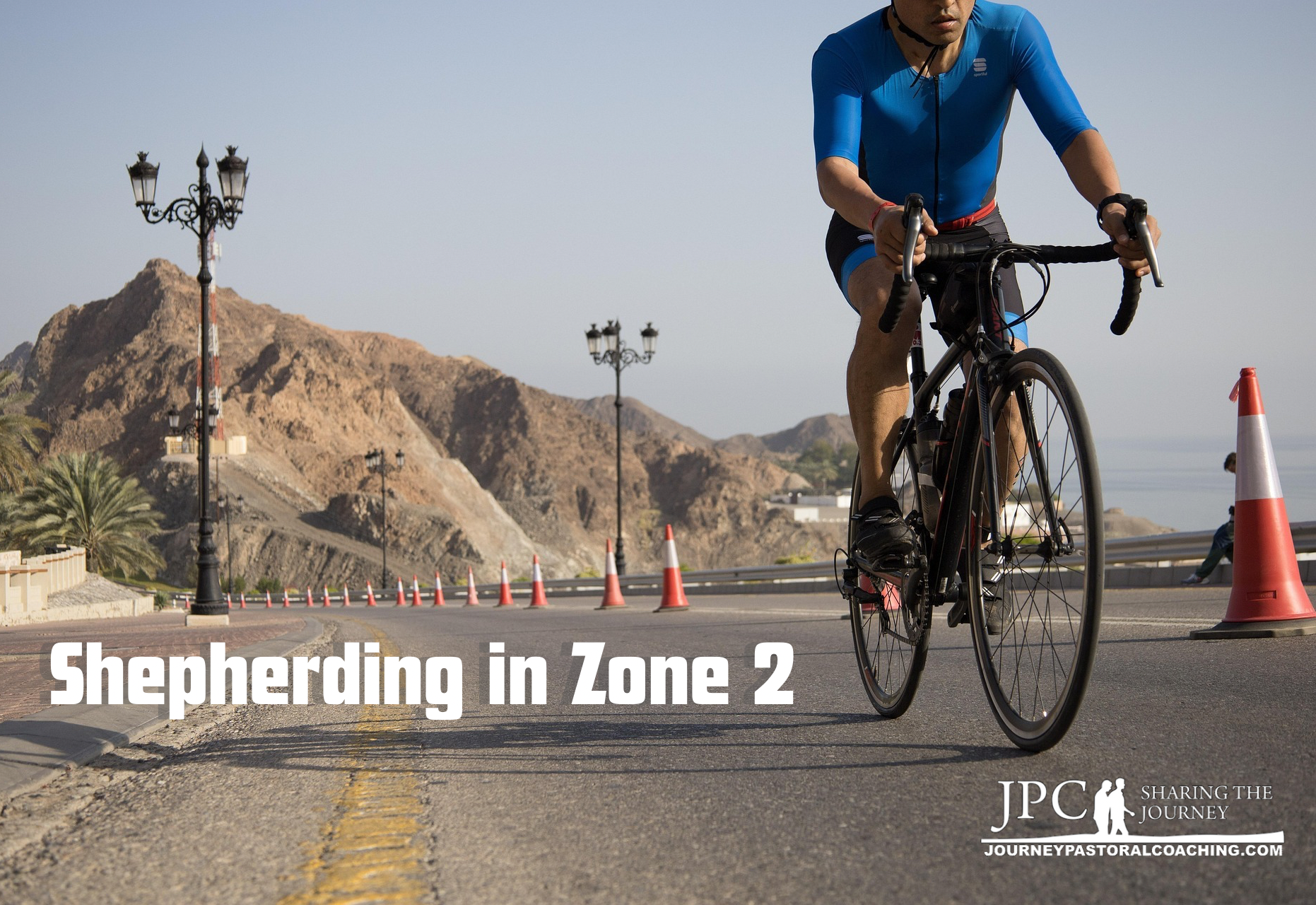
Shepherding in Zone 2
Almost five years ago, I began cycling again. Like most people, I rode a bike as a child, but this was something different altogether. I wasn’t chasing nostalgia, but health. I needed to move my body and clear my mind, and the original “freedom machine” was the perfect vehicle for the job. Little did I know that the unremarkable Eurobike I ordered off Amazon for $350 would become more than a tool for exercise. It would quietly reshape my physical health, and over time, become a living metaphor for how I understand pastoral ministry.
As I learned to ride longer and farther, I was introduced to the idea of Zone 2 training. Rather than an all-out assault on the pedals, cyclists described Zone 2 as a steady and intentionally subdued pace. It didn’t promise quick gains or fast visible results, but it was hailed as essential for any serious cyclist. Even before I could explain it, I recognized in it a familiar pattern, one that echoed the long, unseen work of pastoral ministry. In this article, I will explain how pastoral ministry can translate the lessons of Zone 2 cycling, offering a way of shepherding that resists hurry, honors limits, and quietly forms endurance. I call this approach shepherding in Zone 2.
Understanding Zone Training (The Nerdy Stuff)
Cyclists use five heart rate zones to understand their training. These zones are subtle levels of exertion that help the body adapt. Zone 1 is about 50-60% of your maximum heart rate. It is used for recovery and loosening up the legs. Next, Zone 2 is between 60-70%, and allows for a steady comfortable pace, which is important to build endurance. The next heart rate level is Zone 3, which is 70-80% of your maximum heart rate. It requires focus as breathing becomes more labored. At 90-100%, Zone 5 is for short maximum-effort bursts. By using these zones, cyclists learn to push themselves and also to hold back, developing strength through both effort and controlled exertion.
As mentioned above, Zone 2 training is when you’re at 60-70% of your max heart rate. At this heart rate, the rider is at what cyclists call a “conversational pace.” It’s when you can speak in full sentences without losing your breath. In recent years, some elite cyclists, like UCI World Champion Tadej Pogacar, admit that most of their training is in this zone. While in this zone an aerobic base is established, a fat-burning efficiency, and the cyclist has sustainable power. In short, this is their forever pace.
Zone 2 training is important because it targets the body’s aerobic energy system, the system responsible for producing energy efficiently over long periods of time. At this heart rate, the body relies primarily on oxygen to convert fat and glycogen into usable energy inside the mitochondria. Repeated exposure to this intensity stimulates mitochondrial biogenesis, meaning the body builds more and healthier mitochondria, which are essentially the engines of endurance. Capillary density increases as well, improving blood flow and oxygen delivery to working muscles. Over time, this makes the cardiovascular system more efficient, lowering heart rate at a given pace and allowing the same work to feel easier.
Equally important, Zone 2 improves metabolic flexibility, the body’s ability to use fat as a primary fuel source while sparing limited glycogen stores. Because stress hormones like cortisol remain relatively low at this intensity, the body can adapt without excessive fatigue or breakdown. This creates a foundation that supports harder training later, such as threshold or VO₂ max work, without overloading the nervous system. In simple terms, Zone 2 teaches the body how to work longer, cleaner, and more economically. It may feel unremarkable in the moment, but physiologically it is where endurance is quietly built at the deepest level.
Honestly, when I first implemented Zone 2 training, I doubted all the hype. It felt almost pointless, too easy to matter, too slow to be productive. The rides were quiet, and well, boring! I had to fight the constant urge to surge, to dance on the pedals, to prove I was really working. Yet, over time, these restrained rides began to reshape my fitness in ways harder efforts never had. My endurance deepened, my recovery quickened, and consistency replaced exhaustion. What looked like less effort was actually the work that made everything else possible. My experience forced me to reconsider how often I confuse intensity with effectiveness, not just on the bike, but in ministry as well.
The Problem with “High-Zone Ministry”
In ministry, there is a pattern of peaks and valleys. Each of these spiritual landscapes require different levels of ministry intensity. Mountains in ministry, like a difficult church board or congregational infighting, take a toll on the minister’s soul. Peaks experiences are temporary and often lead to ministers coasting into shadows of lonely valleys. Many pastors experience conference highs, retreat breakthroughs, emotional worship experiences, or high attendance Sundays. However, these high-output moments do not last.
For example, after a dynamic worship service on Sunday, many pastors crash into Monday morning blues filled with spiritual emptiness. Ministers simply can’t sustain the intensity. In fact, as a younger minister, I was always warned about the mountaintop and valley experiences by older ministers, but no one warned me about the unrelenting, and seemingly endless, plains in pastoral ministry where there is no visible increase or decrease in the spiritual landscape. It is during these times that a minister must simply endure as a faithful steward.
Often, Christian culture, at least in the American context, places a premium on these high-intensity moments. We celebrate the visible highs of spirituality, the seasons of intensity, urgency, and apparent victory. Conferences are built around them. Testimonies are framed by them. Ministry success is often measured by moments that look like spiritual sprints. And if we are not careful, we can begin to believe the lie that pastoral ministry is always about these moments. Thus, placing us on a hamster wheel of performance culture, instead of gospel culture.
Scripture gives us a sobering example in the life of Elijah (1 Kings 18-19). On Mount Carmel, Elijah experienced one of the most dramatic victories in the Bible. God answered his prayer with fire from heaven, exposing the impotence of Baal and vindicating the faithfulness of the Lord before the watching people. It was a moment of extraordinary power, courage, and public faithfulness. It was definitely a high-intensity moment in Elijah’s ministry.
Yet the very next chapter reveals the cost of living in constant spiritual acceleration. When Jezebel threatened his life, Elijah did not respond with renewed boldness. Instead, he fled into the wilderness, collapsed under exhaustion, and prayed that he might die. The prophet who stood unflinching before hundreds of false prophets now found himself depleted, fearful, and alone.
Elijah’s collapse was not the result of failure at Carmel, but of what followed it. A sustained sprint, even when fueled by genuine obedience, left him without reserves. Before God addressed Elijah’s theology or calling, He addressed his exhaustion. The Lord provided sleep, food, and quiet before He offered instruction. Elijah did not need another display of fire. He needed restoration.
The lesson is not that Mount Carmel moments are unnecessary or wrong. God does use seasons of intensity for His purposes. The danger comes when those moments become the model for all of life and ministry. When sprinting becomes the norm, exhaustion becomes inevitable, and discouragement is never far behind.
This begs the question: are we training for spiritual sprints or spiritual marathons? Answering that question requires a different vision of pastoral formation, one oriented toward sustainability rather than spectacle. One, I believe, is witnessed in Zone 2 shepherding.
What Zone 2 Shepherding Looks Like
Zone 2 shepherding centers on daily spiritual disciplines. To name only a few, there is prayer, Scripture reading, worship, solitude, and silence. Each of these disciplines can be taken to the extreme, and sometimes that is needed. However, Zone 2 shepherding is a sustainable rhythm, not a full-throttle pace.
This model of shepherding resembles the long season of base training cyclists return to every year. The rides aren’t heroic, but they are consistent. It’s the same roads, same cadence, same commitment to showing up. You don’t chase intensity; you trust the slow accumulation of miles. In the same way, daily prayer, Scripture, and silence shape the soul through repetition, forming a shepherd who can endure without burning out.
How can you discern what a “conversational pace” of ministry looks like? Unfortunately, Garmin hasn’t developed a device to track the state of our souls, but Scripture gives us a reliable starting point. Listen to your words. Jesus tells us that “out of the abundance of the heart the mouth speaks,” (Matt. 12:34; Luke 6:45) and Proverbs warns us to guard our hearts, for from them flow the springs of life (Prov. 4:23). Our speech often reveals our spiritual heart rate before anything else.
Cyclists know they’ve drifted out of conversational pace when talking becomes strained or clipped. In the same way, irritation, cynicism, or constant urgency in our words can signal that we’re riding beyond a sustainable rhythm. From there, examine your capacity. Can you remain present with your family and attentive in your work while maintaining spiritual awareness? Do your spiritual disciplines leave you strengthened or quietly exhausted? If they drain you, your pace likely needs adjustment. Zone 2 shepherding builds the capacity required for seasons when intensity is necessary; without demanding that we live there all the time.
Let’s get further into the weeds for a moment with a personal example. I’ve found that silence, solitude, and meditation are keys to my spiritual growth. However, as a husband, father, and pastor, I cannot retreat indefinitely from ordinary responsibilities in pursuit of uninterrupted spiritual disciplines. The work God has entrusted to me is lived out in interruptions, conversations, and long obedience in familiar places. What I need, then, is not escape, but a rhythm that allows formation to happen within the demands of everyday life. Zone 2 shepherding is not about withdrawing from people, but learning how to remain present, faithful, and attentive in the margins of life over time.
The Long-Term Benefits
Zone 2 shepherding forms a kind of endurance that allows pastors and believers alike to weather long seasons of difficulty. When suffering lingers, when prayers feel unanswered, or when ministry progress seems slow, this steady formation provides resilience rather than collapse. Faithfulness is sustained not by adrenaline, but by depth.
This kind of shepherding also produces steady progress rather than the familiar boom and bust cycles that plague much of modern ministry. Instead of alternating between seasons of frantic activity and emotional depletion, Zone 2 rhythms cultivate consistency. Growth may be less visible in the short term, but it is far more durable over time.
One of the quieter gifts of Zone 2 shepherding is sustainable joy. This joy is not dependent on emotional highs, successful events, or dramatic outcomes. It is the settled joy of abiding faithfulness, the kind that remains present even when ministry feels ordinary or unseen. It does not spike quickly, but neither does it disappear when circumstances change.
Importantly, when life does demand spiritual sprints, Zone 2 shepherding provides the necessary base. There are moments when urgency is unavoidable, moments of crisis, grief, or intense leadership demand. Those moments are not the problem. The problem is living there. When the foundation of faith has been patiently formed, those sprints become possible without becoming destructive.
I learned this firsthand when I hit a wall during a prolonged season of strain, a season that was only intensified during the aftermath of Hurricane Helene, which devastated my community. Ministry demands increased, uncertainty mounted, and the emotional weight of shepherding people through fear and disruption pressed heavily. What sustained me in that moment was not a sudden surge of spiritual intensity, but the quiet habits already in place. Prayer that did not need to be dramatic. Scripture that did not need to be novel. A faith that had been trained to endure rather than impress. Zone 2 formation did not remove the difficulty, but it gave me the capacity to remain present within it.
That is the quiet power of Zone 2 shepherding. It prepares us not just for moments of visible faithfulness, but for the long obedience that ministry and the Christian life require.
Practical Application
Zone 2 shepherding always begins by starting where you are. The goal is not to imitate someone else’s spiritual routine or to overhaul your life overnight. It is to establish rhythms that can be sustained in the season God has actually given you.
A helpful question to ask is this: what daily practices can you maintain even on your busiest days? If a practice only works in ideal conditions, it will not endure. Zone 2 formation favors small, repeatable habits that fit within ordinary life rather than occasional moments of spiritual intensity.
Patience is essential. Just as Zone 2 training takes time to produce visible results, spiritual formation often works quietly beneath the surface. Early on, progress may feel slow or unimpressive. Resist the urge to abandon the process simply because the fruit is not immediately obvious.
A simple training plan can help establish these rhythms without overwhelming you. Here is a suggestion:
- Weeks 1-2: Commit to ten minutes each day of Scripture reading and prayer. Keep it modest and consistent. This is not sermon preparation! Resist the urge to sprint into feeding others, feed yourself!
- Weeks 3-4: Add a brief gratitude practice. This might be as simple as naming three gifts from the day before God. Write them in a journal. But resist posting it for public consumption on social media or a personal blog. This is your time alone with your Heavenly Father. Enjoy it! Don’t put any pressure on yourself to perform.
- Weeks 5-6: Incorporate a small act of intentional service. Look for ordinary opportunities to serve others without adding new commitments. This maybe as simple as taking out the trash without being asked or unloading the dishwasher when it’s not your turn. Keep it simple, sustainable.
From there, continue to build gradually, adding practices only as they can be sustained. Zone 2 shepherding is not about doing more, but about forming a life and ministry that can endure.
Conclusion
Try Zone 2 shepherding for ninety days. Resist the urge to measure success by how intense it feels. Instead, pay attention to what is quietly forming beneath the surface. Over time, you will discover a spiritual capacity you did not know was possible.
This approach reflects the rhythms of Jesus Himself. The Gospels show Him rising early to pray, participating regularly in synagogue worship, and withdrawing for rest and solitude. These were not dramatic moments, but faithful patterns. They sustained Him for a life of costly obedience and compassionate presence.
The strongest cyclists are not those who only sprint, but those who have logged thousands of steady miles. The same is true of pastors and Christian leaders. Endurance is not built in moments of intensity, but through long, faithful practice.
Zone 2 shepherding does not promise quick results or fast visible success. What it offers instead is something far more valuable. A ministry, and a life, that can endure.
Bio

Kevin W. Bounds is a pastor, writer, and endurance cyclist behind the As You Go Cycling blog, where faith and miles meet. Through reflections on cycling, Scripture, and everyday life, he explores sustainable discipleship, spiritual rhythms, and the long obedience of following Christ on two wheels!
Upcoming journeys include the 300-mile Key West Bike Ride with Ends of the Earth Cycling and a bikepacking mission trip in Mongolia with IMB. Through these rides, Kevin invites readers to follow along as he explores perseverance, presence, and trusting God on the long road, where faith is often formed between destinations rather than at them.
———-
NOTE: Journey Pastoral Coaching exists to provide pastoral coaching to Millennial ministers.
Saddled with large student debt, just beginning to set up homes and start families, and serving in low paying first and second positions, Millennials are those who most desire but can least afford to pay for pastoral coaching.
We are able to do so thanks to the faithful and generous support of individuals and churches like yours who want to see young leaders not only enter the ministry, but remain in the ministry.

Now, more than ever, we need your help.
If you or your church would like to help Millennial ministers across the US and overseas build strong for a lifetime in ministry, please click here to support Journey monthly or with your one-time gift. Thank you.
We also invite you to click and subscribe to our twice-monthly blogs at journeypastoralcoaching.com

Leave a Reply
Your email is safe with us.