

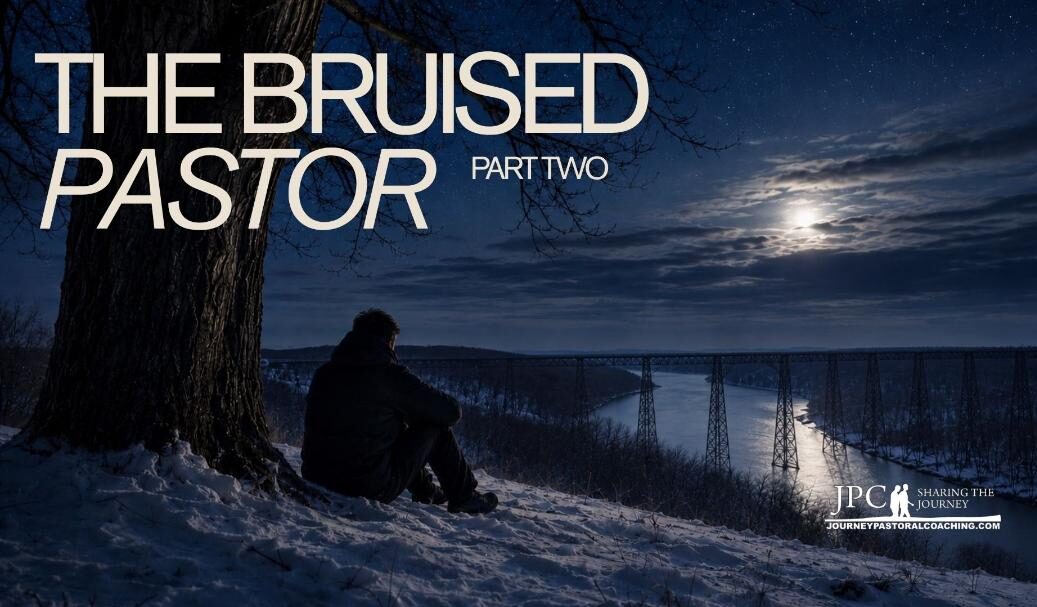
The Bruised Pastor – Part Two
It’s been 13 years since that night I sat with my back to the elm tree. At times it’s hard to imagine that many years have passed; and yet, I can still feel every detail of the bark pressed up against my back. There are days when it feels like I never left that spot, like my life has been one long season of bruising since then.
That’s not entirely true. I’ve had three sons since then, each a reflection of God’s grace to me. My wife and I have 13 more years of life together since then that have taken us into a deeper relationship than I could’ve imagined. There have been many, many good things. But God hasn’t stopped using suffering to shape me. It’s happening even as I write this in ways I can’t yet talk about publicly.
This leads me to ask: What if the bruising doesn’t stop? What if it goes on for the rest of my life? Is there anything I can or should be doing while this season continues?
Yes… and no.
I would love to be able to hand you four easy steps to get up from the elm tree and escape the pain. But, I wouldn’t want you to miss what God may be doing in your life as you sit with your back against the elm tree. There’s a deeper work God does in us while we experience the pain of that bruising. At the same time, we are not completely passive in that work. So, with that in mind, I want to dig a little deeper here than I did in part 1 and get to the heart behind these questions, adding some practical steps we can take in this bruising season.
It’s tempting to find noble or even “holy” ways of numbing or escaping the pain of these bruising seasons. If I focus on staying busy at church, I won’t have time to feel the loneliness. If I preach enough… If I travel enough… If…
As these seasons stretch on over the years, the temptation to become bitter or to numb our pain becomes a matter of survival. So when the bruising doesn’t stop, what else can you do? You can’t stop working. Your family would starve, right?
That’s true, but I want to surgically explore your motives with you for a moment.
Kids have curious minds that instinctively want to explore and understand. It all starts with one simple question: “Why?”
This question can create an infinite regression where the response to the answer is again, “Why?” Why is the sky blue? Because it reflects refracted light. Why does light refract? Because different wavelengths of light travel at different speeds through different media. Why does it do that? And on and on and on we go.
I want to have this same curiosity when it comes to understanding what motivates me to continue getting up in front of a congregation on a Sunday morning. Am I taking advantage of this good work as a distraction from my pain? If I’m taking advantage of this as a distraction, what about my pain am I trying to escape? If I’m trying to escape pain, am I not trusting God? Why don’t I trust God in this area? And on and on and on we can go.
If I stop at the first layer and say, “Yeah, I’m probably distracting myself” but don’t dig deeper, I may find that my eyes have shifted away from the God of all comfort to seek validation and value in what I do. “I may feel terrible, but at least I’m still creating value, and that must mean I’m worth something even though I don’t feel it.”
In contrast to this, I may find I’m serving in my role from the place God has led me in this season. This service is from a place of humility: “I can’t hide my brokenness this morning. But I’m here to offer what I do have. By God’s grace I stand here, and even though I’m hurting, He is still good.”
These two responses are the pulse we can measure to know how we’re responding to God in this season of bruising. If our response grasps at activities that preserve our value, we’ve taken our eyes off of Christ and begun to apply our own salve to the wound. If our response keeps our focus on Christ and the eyes of everyone around us on Christ, we know humility has done its work. Our healing and sanctification are in the hands of the Good Shepherd.
So with that in mind, these practical steps are focused on this second, healthy response to the bruising. They are activities that help to expose our desire to escape the pain, help to keep our eyes fixed on Christ, and help to ensure we humbly serve the body of Christ in the middle of the bruising season. Each of these is pulled from Scripture, the saints throughout history, and my own experience.
Step 1: Flood Your Mind with Scripture
This is tedious, dry, boring, and frustrating work in the bruising season. It’s also one of the last things we want to do. We KNOW what the Scriptures say. We KNOW what God’s going to tell us. But we don’t FEEL it. We don’t FEEL the joy in discovering God’s truth. We don’t FEEL that truth in our souls because of the pain. We don’t FEEL God’s love and grace.
But, this is vital! Psalm 1 reminds us the blessed man’s “delight is in the law of the LORD, and on his law he meditates day and night.” God told Joshua, “This Book of the Law shall not depart from your mouth, but you shall meditate on it day and night” (Joshua 1:8). Scripture is food for our souls. We cannot live without it. While our mind and physical body don’t want to read Scripture in this season, our soul craves it.
Martin Luther noted, “It is thus very true that we shall find consolation only through the Scriptures, which in the days of evil call us to the contemplation of our blessings, either present or to come” (Luther’s Works, Vol. 42). In other words, meditating on Scripture is a constant reminder to us of the reality of God’s grace in our lives, especially when we don’t feel it.
When you smoke a large piece of meat, like a brisket or pork shoulder, there’s a point where the meat goes from solid and chewy to melty and tender. That moment is the temperature where fat and collagen in the meat breaks down and liquifies. This doesn’t and can’t happen by instantly getting the meat to that temperature. It takes low heat that allows the proteins in the muscle to remain relaxed (tender) without seizing up and constricting (overly chewy). This low, constant heat allows the meat temperature to rise to the melting point of collagen without seizing the proteins. This is why a brisket can take half a day to cook.
Our repeated exposure to Scripture, our saturation in Scripture, is the low and slow cooking in the bruising season. It takes a long time. It feels like nothing happens from one day to the next. But this work gradually keeps our attention on Christ, if only subconsciously. It reminds our souls time and time again that our pain and bruising is not the center of all things, Christ is. That truth doesn’t cure our bruising instantly. But the long and low heat of meditating day and night will change us.
Step 2: Examine the Pain
We have a tendency to think the pain should disappear and that the pain is our problem. But, as I noted before, pain may be only a symptom. Don’t miss this opportunity to examine what’s going on in the middle of it.
Proverbs 20:5 reminds us, “The purpose in a man’s heart is like deep water, but a man of understanding will draw it out.” And Psalm 139:23-24, “Search me, O God, and know my heart! Try me and know my thoughts! And see if there be any grievous way in me, and lead me in the way everlasting!” Evaluating our thoughts, motives, and pain is valuable work.
For example, if in your pain, you find yourself short-tempered (like I often do), take a hard look at why you feel justified or feel the need to let your anger loose on those around you. Does it make you feel in control? Are you really angry with God, and your spouse is simply in the blast radius? Examine the ins and outs of your emotions and behaviors. Like a child, keep asking “Why?” until you get no further answers.
Do this in your private time. Do this with a trusted and honest friend. Do it with a professional counselor (some wounds are deeper than we can expose on our own and require someone who’s seen this wound and its effects before). And most importantly, do it with our spiritual counselor, the Holy Spirit. He’s with you in this season. He’s the one leading you through this season. He WANTS to help you in this way.
That night at the elm tree, my wife thought I’d never come back… I did. But some don’t.
Some of us in ministry head out to the elm tree and decide to end the pain permanently. You are not alone in this. Isolation has killed many ministries and ministers, literally. If this is where you’re at now, please ask for help. You can call or text 988 for immediate, emergency mental health help. Ministers, especially those in the middle of a bruising, aren’t immune to these thoughts.
Brennan Manning, in one of my favorite books, The Ragamuffin Gospel, wrote, “When I get honest, I admit I am a bundle of paradoxes. I believe and I doubt, I hope and get discouraged, I love and I hate, I feel bad about feeling good, I feel guilty about not feeling guilty… To live by grace means to acknowledge my whole life story, the light side and the dark.” It’s when we examine ourselves and see who we are in light of God’s grace, our good and our bad, that we find our eyes move from our problems and onto Christ.
Don’t take this on as a way of quickly solving the problem so you can move out of the bruising season. As I noted in the previous article, don’t rush this work. Explore it as thoroughly as you can stomach. Take a break. Then come back for more. There’s a wealth of understanding waiting to be drawn out.
Step 3: Take a Break
Sometimes you just have to rest. Jesus said, “Come to me, all who labor and are heavy laden, and I will give you rest. Take my yoke upon you, and learn from me, for I am gentle and humble in heart, and you will find rest for your souls” (Matthew 11:28-30). Brennan Manning explained that verse this way: “When Jesus said this… He assumed we would grow weary, discouraged, and disheartened along the way” (The Ragamuffin Gospel). This was part of the shepherd/sheep relationship David mentioned in Psalm 23: “He makes me lie down in green pastures. He leads me beside still waters. He restores my soul.“
There are two ways this applies:
First, there are times when stopping all work is wise. If your pain has you in such a state that you’re no longer effectively ministering, if your pain affects your ability to function safely, that in itself is a symptom of something God may be doing in your life in this season. Perhaps, your definition of success doesn’t align with God’s definition of sanctification and healing in your life.
Second, it’s also not healthy to spend so much time on steps 1 and 2 that you become obsessed with those and lose sight of the joy of simply being a child of God. You can reinforce God’s love and grace in your life by putting yourself in nature, sitting in the dark, driving to another town and getting a hotel room, going camping, something other than your normal day-to-day existence.
This may feel just as draining at first as well. You might feel your perceived value going down because you’re not DOING what you’re called to do. You might feel nothing at all and that you’re wasting your time. But, just like with reading Scripture, this is about gradual, low and slow work.
Did you know your nose is always in your field of vision, but you don’t notice it because your brain has filtered it out?
When the world around us is familiar, our habits, our morning coffee, our living rooms, our bedrooms, and the world around us begin to disappear into the background. We don’t notice them as much any more.
When our brains filter out our environment and we don’t notice it any more, our hearts and thoughts tend to turn inward. It’s as though our brains are looking for something to occupy the space, and when our environment is filtered out, the only remaining input is our inward thoughts. When everything turns inward like this, we begin to turn away from Christ. Our hearts are naturally deceitful and self-obsessed.
We need to take breaks and reconnect with our environment. Some call this mindfulness. In his book, Get Your Life Back, John Eldredge talks about doing this by driving with the windows down, smelling the world around you, hearing the sounds, feeling the wind. Don’t disconnect by keeping a screen between you and the world.
When you take a break, you disrupt the self-obsessed thought patterns. It’s not enough just to take a break though. You have to take the kind of break that allows your heart to return to Christ. Keep the distractions of social media and the rest of the internet away. Keep away from media and other activities we all use to numb ourselves. True rest is not a numbing disconnect, it’s a pause to remember every breath is dependent on God and that he has given us more goodness than we deserve. Touch the grass. Feel the wind. Hear his creation around you.
Step 4: Read What the Saints Wrote and Left for Us
Hebrews 11 is the demonstration of this par excellence. And after listing all the heroes of the faith, the author of Hebrews concludes, “Therefore, since we are surrounded by so great a cloud of witnesses, let us also lay aside every weight, and sin which clings so closely, and let us run with endurance the race that is set before us” (Hebrews 12:1). Hebrews is a warning against giving up and leaving the faith. And the prescription for avoiding this apostasy is simple, looking at all the people around us, seeing how they lived their lives of faith, let us fix our eyes on Jesus. We read Scripture and the saints throughout history for this reason. Their lives and their writing turn us toward Christ.
I mentioned several of these sources in my last article. This is important. Read things that were written more than 200 years ago. If it survived this long, there is value and wisdom to be gleaned. It has stood the test of time. There’s plenty of value in modern authors, but you have to exercise judgment more actively to find the timeless wisdom. What’s popular today doesn’t necessarily stand the test of time over 200 years just because it’s popular. If it’s been popular for hundreds of years, you have the accumulated testimony of millions of people that what is said here holds truth worth reading.
Charles Spurgeon loved reading the Puritans. In his lectures to Pastors’ College students, he said, “Renounce as much as you will all light literature, but study as much as possible sound theological works, especially the Puritanic writers, and expositions of the Bible.” These Puritan writers have stood the test of time. They’re prime reading in long seasons of bruising.
A lot of this reading won’t be easy though. You’ll need to spend some time working through authors like John Owen. But you can also rest as you do this, knowing that what you’re reading is a good meal for your soul.
These works almost always do two things: 1. They focus on Christ and his glory. 2. They connect everything to Scripture (thus reinforcing step 1 above).
Look to Jesus
There is really only one goal in the long season of bruising once you’ve accepted this gift of grace from God. To finish the quote from Hebrews earlier now: “Therefore, since we are surrounded by so great a cloud of witnesses, let us also lay aside every weight, and sin which clings so closely, and let us run with endurance the race that is set before us, looking to Jesus, the founder and perfecter of our faith, who for the joy that was set before him endured the cross, despising the shame, and is seated at the right hand of the throne of God.“
Each of the steps here has that goal in mind. He is our anchor. These are Scripture-prescribed steps. These are tried and proven steps by saints throughout history. And I can tell you today that even now, 13 years after that night at the elm tree, they are proving invaluable in my life. It doesn’t mean they’ve made my pain go away. But God is good. And when I keep looking to Him, I find His grace pervading every area of my life more and more.
Really, this should be the way we live all the time. When we move away from this focus on Christ, we find ourselves tempted to need Him less. This often happens in the peak periods of life that C. S. Lewis noted were prime opportunities for temptation and failure (The Screwtape Letters, Letter VIII). God allows us these trough periods as a gift of grace to keep us humble and allow us to refocus our lives, thoughts, and hearts on him.
We can’t “fix ourselves” in this season. We can’t rush through it to heal the pain faster. When we do so, we miss the point. We take implicit control in hopes that we can, by our own power and ability, make the pain go away. But, as I noted before, this is exactly the opposite of the opportunity in front of us in this season. The real depth of the Christian life comes as we experience these seasons over and over again, only to greet pain and suffering as the sacred place where we are brought to our lowest point and from there look up to our savior.
BIO: Josh Havens lives in the Springfield, MO area with his wife and three sons. His passion for discipleship, coaching, and solving puzzles keeps him engaged in deep conversations. Learning to walk in God’s grace is his greatest joy and challenge. He’s a software developer by vocation, leading a team that currently develops educational software services for several government departments of education around the world as well as several seminaries.
NEW TO JOURNEY: THE BIBLE STUDY CHALLENGE:

Journey Pastoral Coaching is privileged to partner with Bible Study Challenge, a unique approach to Bible study designed to help you enjoy your time in the Word, and more deeply understand what you study.
Not only will Bible Study Challenge help make your study of the Scriptures come alive, but your study helps support the ministry of Journey.
Every month brings a new book and challenge. Click here to learn more.
Sign up here for the September Bible Challenge today. The deadline is August 31, 2026.
Remember to use the unique Journey link. Doing so will help support the ministry of Journey Pastoral Coaching.
———-
NOTE: Journey Pastoral Coaching exists to provide pastoral coaching to Millennial ministers.
Saddled with large student debt, just beginning to set up homes and start families, and serving in low paying first and second positions, Millennials are those who most desire but can least afford to pay for pastoral coaching.
We are able to do so thanks to the faithful and generous support of individuals and churches like yours who want to see young leaders not only enter the ministry, but remain in the ministry.

Now, more than ever, we need your help.
If you or your church would like to help Millennial ministers across the US and overseas build strong for a lifetime in ministry, please click here to support Journey monthly or with your one-time gift. Thank you.
We also invite you to click and subscribe to our twice-monthly blogs at journeypastoralcoaching.com
“Of all vocations, surely the gospel ministry is the one whose paradigm is most radically formed by the dynamics of godly mentorship.”
Stephen Baldwin
